


India's Semiconductor Boom Is Creating a Hydrogen Supply Bottleneck
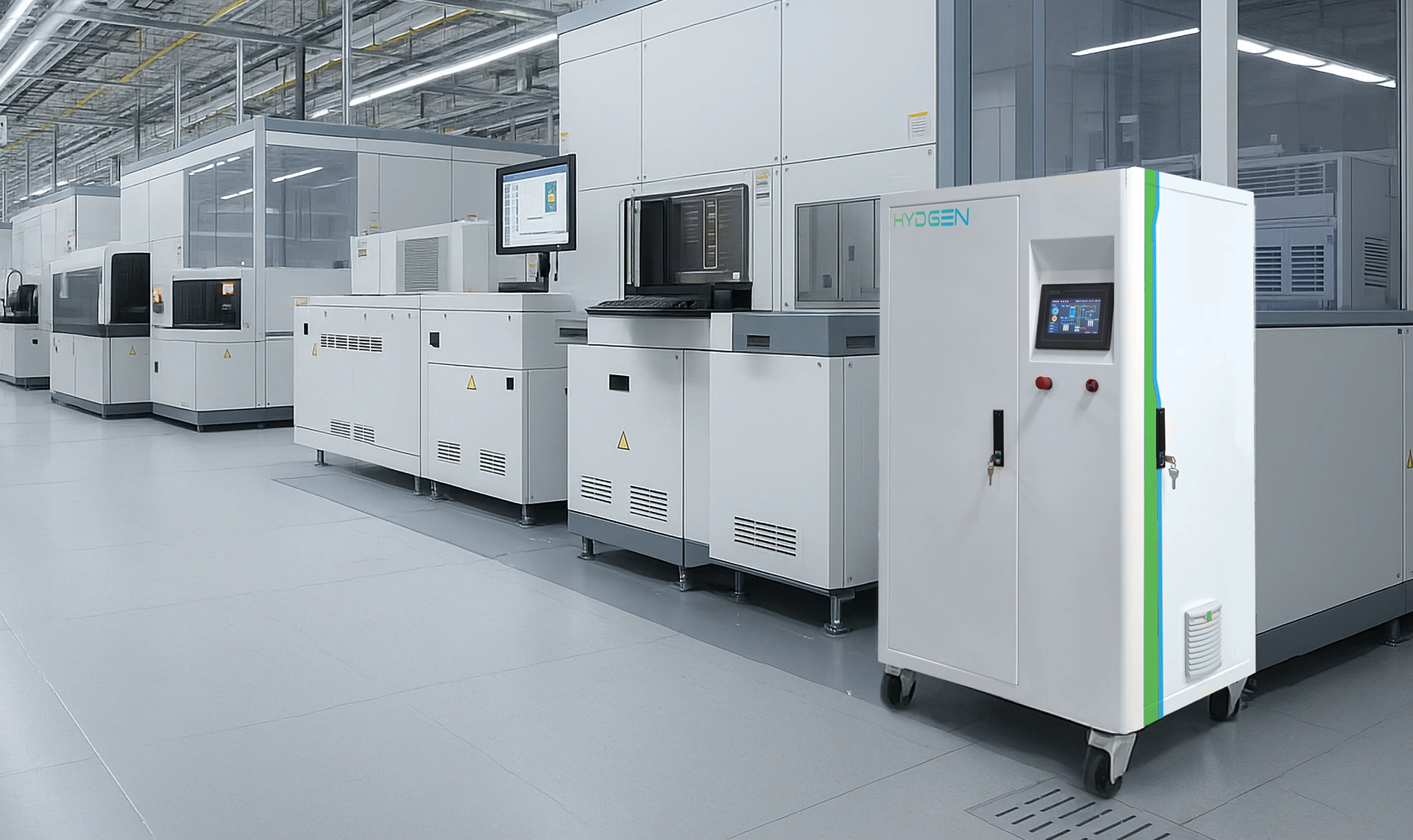
India's semiconductor manufacturing buildout is accelerating fast enough to outpace the specialty gas supply chain it depends on. High-purity hydrogen, alongside oxygen, nitrogen, argon, and a handful of process-critical electronic gases, is a core input to wafer fabrication, oxidation, etching, and packaging and India is structurally reliant on imports to meet that demand.
That combination fast-scaling fab capacity and import-dependent gas supply is a known pattern with a recent precedent. It's worth fab operators, and the specialty gas market serving them, paying attention to before it repeats.
The Scale of the Buildout
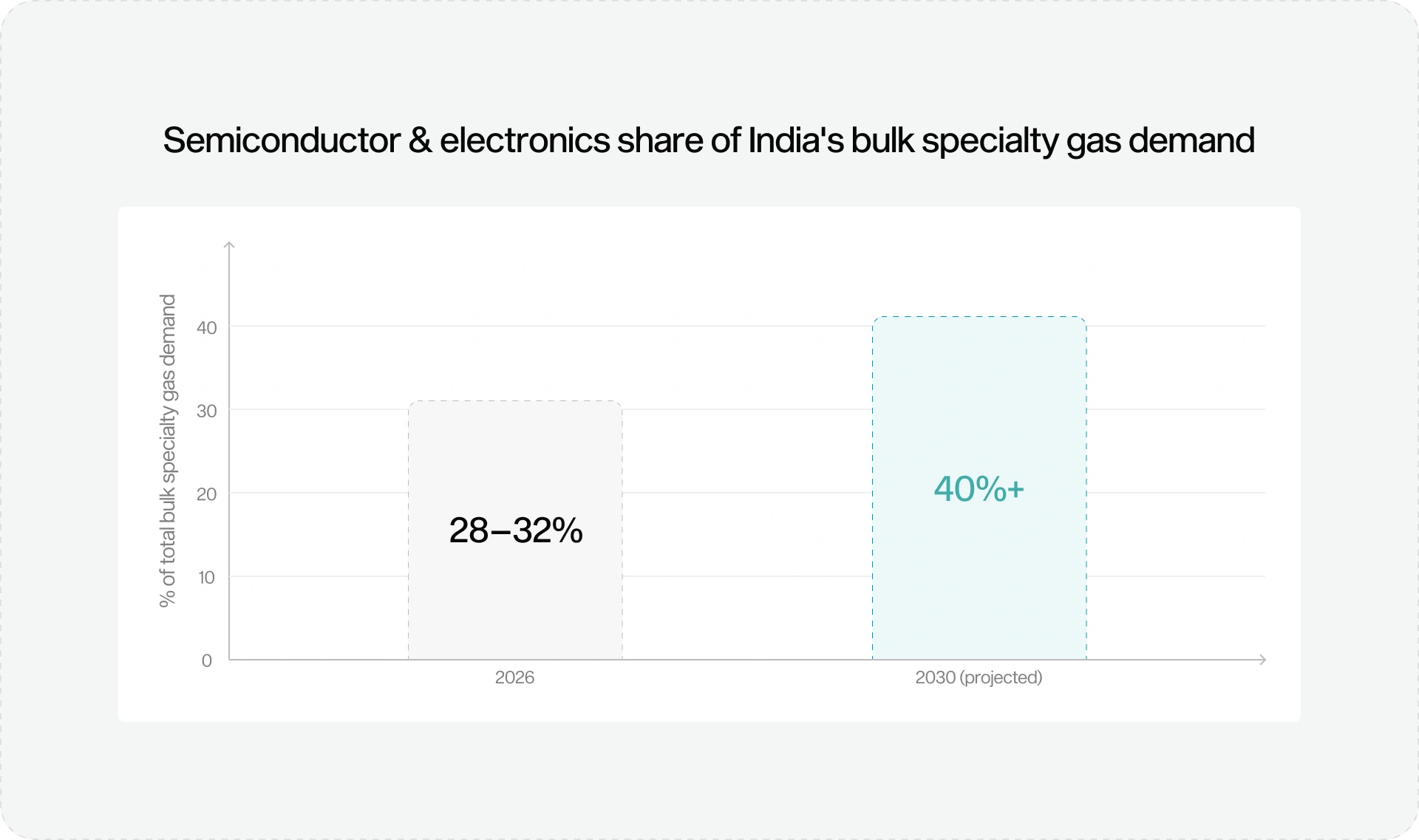
India's semiconductor push is real and moving on a defined timeline. The Micron semiconductor assembly and test facility in Gujarat has been ramping through 2024–2026, the Tata-PSMC fab in Dholera is targeting 2027, and multiple outsourced semiconductor assembly and test (OSAT) facilities are in development alongside them. Electronics and semiconductor manufacturing already accounts for roughly 28–32% of India's bulk specialty gas demand in 2026, a share projected to exceed 40% by 2030 as these facilities move from construction to volume production.
Display manufacturing adds further pressure on the same supply chain: flat panel display fabs producing OLED and LCD panels require high-purity nitrogen, hydrogen, silane, ammonia, and fluorinated gases for thin-film transistor deposition and encapsulation, and represent a meaningful secondary share of electronic specialty gas demand.
The Structural Gap Underneath the Growth
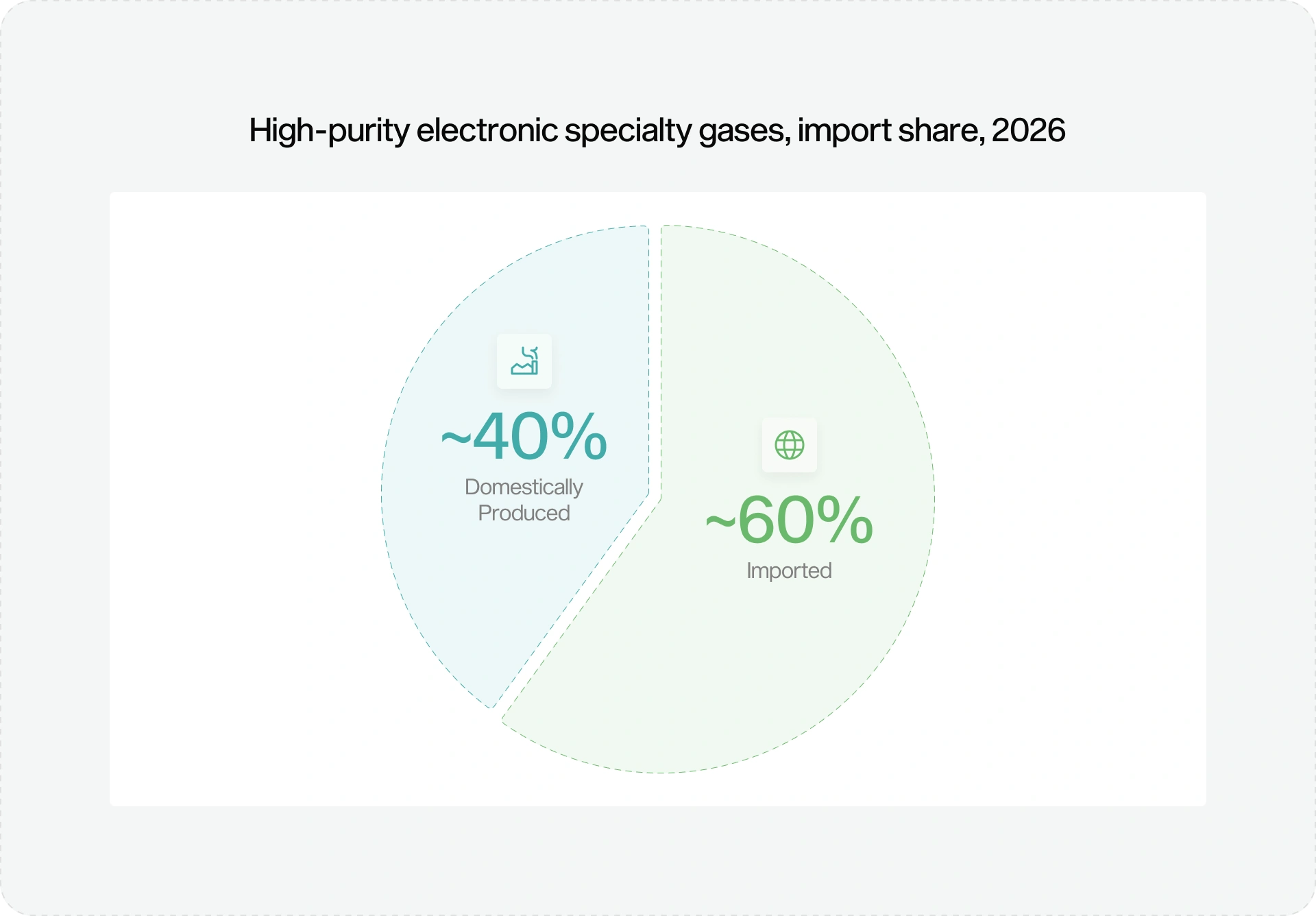
The constraint isn't fab construction it's what supplies those fabs once they're running. India remains structurally import-dependent for the majority of high-purity electronic specialty gases, with import dependence estimated at 55–65% of total specialty gas value in 2026. Domestic production is concentrated in bulk-grade gases nitrogen, oxygen, argon via cryogenic air separation while the ultra-high-purity grades that wafer fabrication actually requires are still largely sourced from global suppliers.
That gap matters because semiconductor fabrication doesn't tolerate supply interruption the way heavier industrial processes can. Wafer fabrication runs on continuous, precisely specified gas flows; a supply disruption or purity shortfall doesn't just delay production, it can compromise product yield on wafers already in process.
A Recent Precedent for What This Risk Looks Like
This isn't a hypothetical. India's electronic gas supply chain has already lived through a comparable shock. During the 2022–2023 global helium shortage, Indian buyers including semiconductor fabs and MRI operators reliant on the same import-dependent supply model faced price increases of 40–60% and allocation cuts of 20–30%. Part of what prolonged the disruption was infrastructure, not just molecule availability: limited specialized tube trailers and cryogenic containers for transport constrained how quickly supply could be redirected, with lead times for new transport equipment running 12–18 months.
Helium and high-purity hydrogen aren't interchangeable, but the supply chain pattern is the same: a specialty gas with limited domestic production, concentrated global sourcing, and transport infrastructure that can't flex quickly when demand spikes or a supplier disruption hits. As India's fab buildout pulls hydrogen demand higher over the next several years, that pattern is the one to watch for.

Why the Industry Is Already Moving Toward On-Site Generation
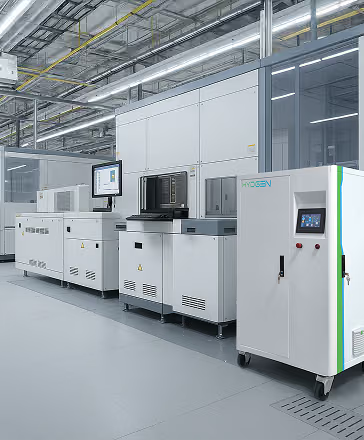
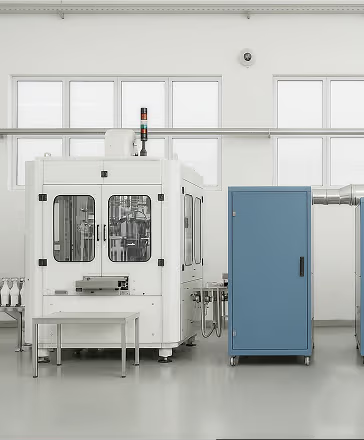
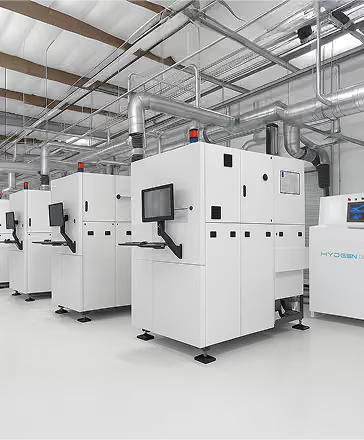
Market analysts covering the broader high-purity specialty gas sector are describing the same structural shift industry-wide: a move from delivered gas supply cylinders and dewars toward on-site generation, particularly for large-volume, high-purity consumers like semiconductor fabs. On-site systems eliminate transportation logistics, reduce the contamination risk associated with cylinder handling, and provide the supply reliability and volume scale advanced manufacturing requires. For the gas industry itself, on-site contracts are increasingly viewed as the structurally preferable model capital-intensive to install, but insulated from the transport bottlenecks and allocation risk that hit delivered supply during shortage events.
For semiconductor fabs specifically, that shift addresses the exact vulnerability the helium shortage exposed: dependence on a global supply chain and specialized transport infrastructure that cannot scale or reroute quickly under pressure. On-site hydrogen generation, sited at the fab itself, removes both the import dependency and the transport bottleneck from the equation supply is a function of local generation capacity, not global allocation and tube trailer availability.

The Question for Fabs Scaling Through 2027–2030
As Micron, Tata-PSMC, and the OSAT ecosystem around them move from construction to volume production, hydrogen demand tied to India's semiconductor sector is set to compound quickly. The operators best positioned through that ramp won't be the ones with the lowest quoted gas price today they'll be the ones whose hydrogen supply isn't exposed to the same import and transport constraints that already disrupted a comparable specialty gas market once this decade.
That's a supply chain resilience question as much as a cost question, and it's worth fabs asking now, while capacity planning is still underway, rather than after the next allocation cut.




Frequently Asked Questions


