


What Trace Contamination Actually Does to a Growing Diamond

In chemical vapor deposition (CVD) diamond growth, hydrogen is not a supporting gas. It is the mechanism that makes the process work at all and its purity determines, atom by atom, whether the result is a clear, high-grade crystal or a stone full of defects.
Most process discussions in CVD diamond manufacturing focus on reactor design, plasma power, and growth rate. Gas purity gets treated as a checkbox: high-purity hydrogen, sourced and confirmed at commissioning. But purity isn't a one-time spec. It's a continuous variable, and small deviations show up directly in the finished crystal in colour, clarity, and yield.
Why Hydrogen Does More Than Fill the Chamber
In the CVD process, a carbon-bearing gas almost always high-purity methane is introduced alongside an overwhelming excess of hydrogen, typically in a ratio near 1 part methane to 99 parts hydrogen. Energy (commonly microwave plasma) breaks down the gas mixture, and carbon atoms deposit layer by layer onto a diamond seed.
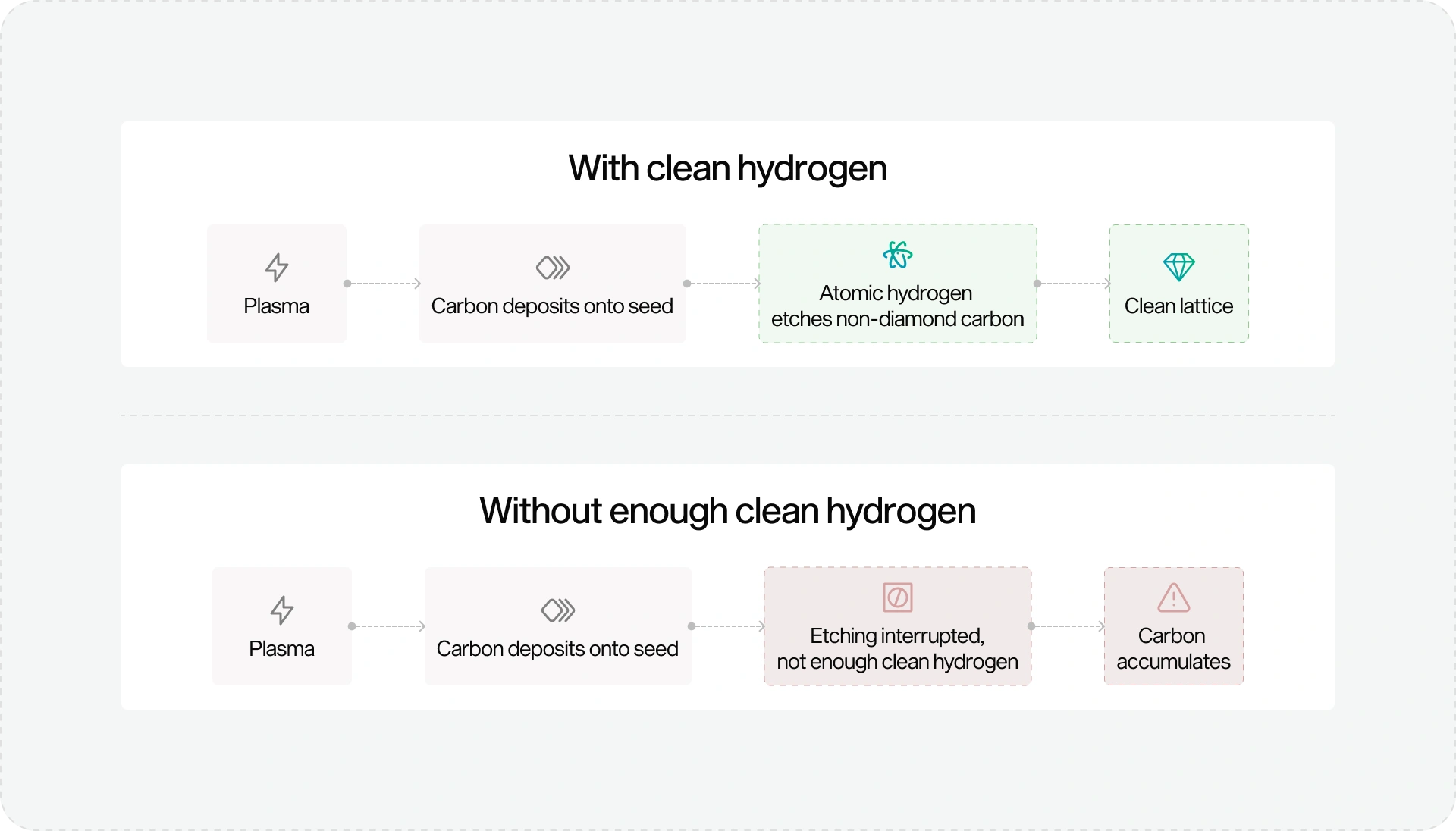
Hydrogen's role in that reaction is active, not passive. Atomic hydrogen selectively etches away non-diamond forms of carbon graphitic and amorphous carbon as they form, leaving only the diamond crystal structure intact. Without a very high ratio of clean, dissociated hydrogen relative to carbon, the process doesn't self-correct: unwanted carbon forms accumulate alongside the diamond lattice instead of being etched away.
This is why hydrogen purity in CVD diamond growth isn't judged by a single percentage figure. It's judged against the specific contaminants that interfere with that etching mechanism.
How Specific Impurities Show Up as Specific Defects
CVD diamond manufacturers typically require hydrogen purity in the 6N–7N range (99.9999% to 99.99999%). At that level, the contaminants that matter aren't bulk impurities they're trace-level intrusions of moisture, oxygen, and residual hydrocarbons, each of which affects the crystal in a distinct way:
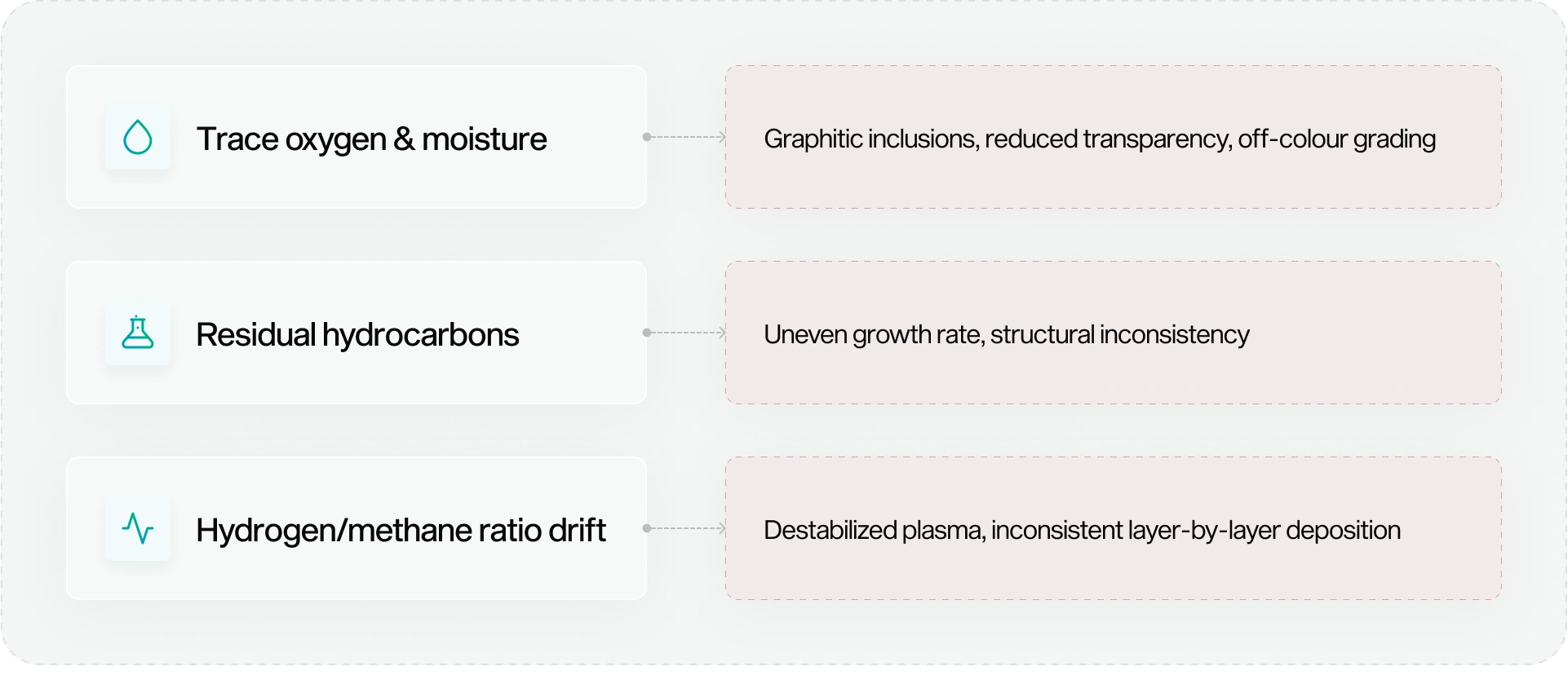
- Trace oxygen and moisture introduce graphitic inclusions and colour-degrading defects. Oxygen interferes with the plasma chemistry that keeps carbon deposition selective, allowing non-diamond carbon to persist in the lattice rather than being etched away which shows up visually as reduced transparency and off-colour grading in the finished stone.
- Hydrocarbon impurities beyond the intended methane feed alter the effective carbon-to-hydrogen balance in the chamber, affecting growth rate uniformity across the crystal and increasing the risk of structural inconsistency.
- Plasma stability itself is sensitive to gas composition. Trace contamination that shifts the hydrogen/methane ratio, even slightly, can destabilize the plasma environment the growth process depends on for consistent, layer-by-layer deposition.
The practical result: consistent 6N–7N hydrogen purity correlates directly with improved crystal transparency and reduced defect density. Purity variation even within a supply that nominally meets spec correlates with variation in the finished product.
Where Purity Variation Actually Comes From
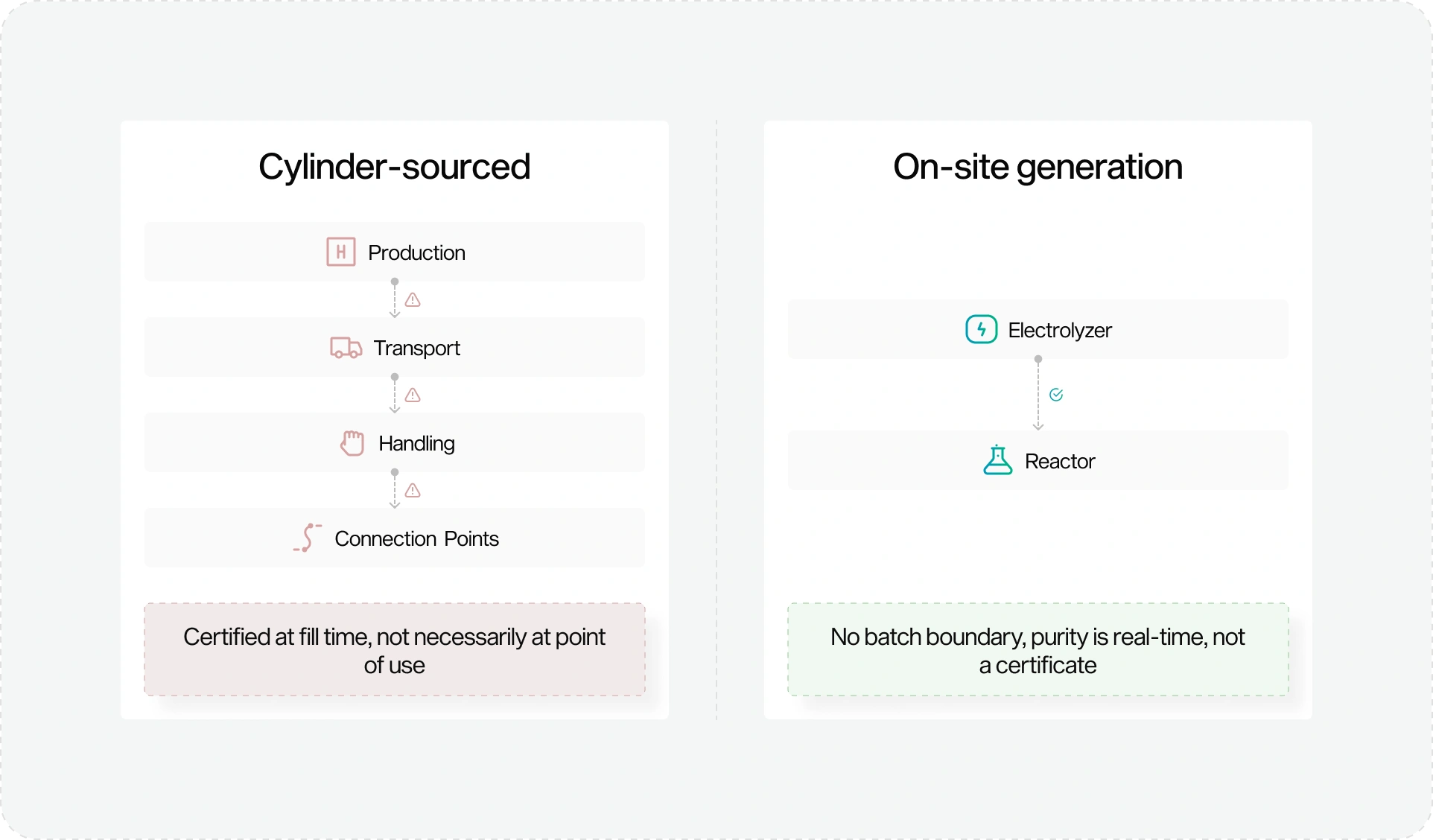
For manufacturers running on delivered cylinder hydrogen, purity variation is a structural risk, not an occasional exception. Cylinder-sourced hydrogen carries batch-to-batch variation by nature each cylinder is a discrete lot, filled and certified independently, and that certification reflects conditions at fill time, not necessarily at the point the gas reaches the reactor. Transport, handling, and connection points each introduce additional opportunity for trace moisture or contamination to enter the stream.
This matters more, not less, as production scales. A single cylinder swap introducing a purity dip might be absorbed into a small batch. At production volume, the same variability compounds across every reactor cycle, and identifying which batch introduced a defect after the fact is often difficult or impossible.
On-site, continuous hydrogen generation addresses this differently: because the generation system and the reactor are connected directly, there is no batch boundary and no transport interval in which purity can drift between certification and use. Purity is a property of the system's real-time operation, not a certificate attached to a delivered cylinder.
The Question CVD Manufacturers Should Be Asking Suppliers
Not "what purity does this system produce at commissioning," but "what purity does it sustain, continuously, under real production conditions and how is that verified."
For manufacturers evaluating or troubleshooting a hydrogen supply, that distinction points to two different problems, depending on where they are today:
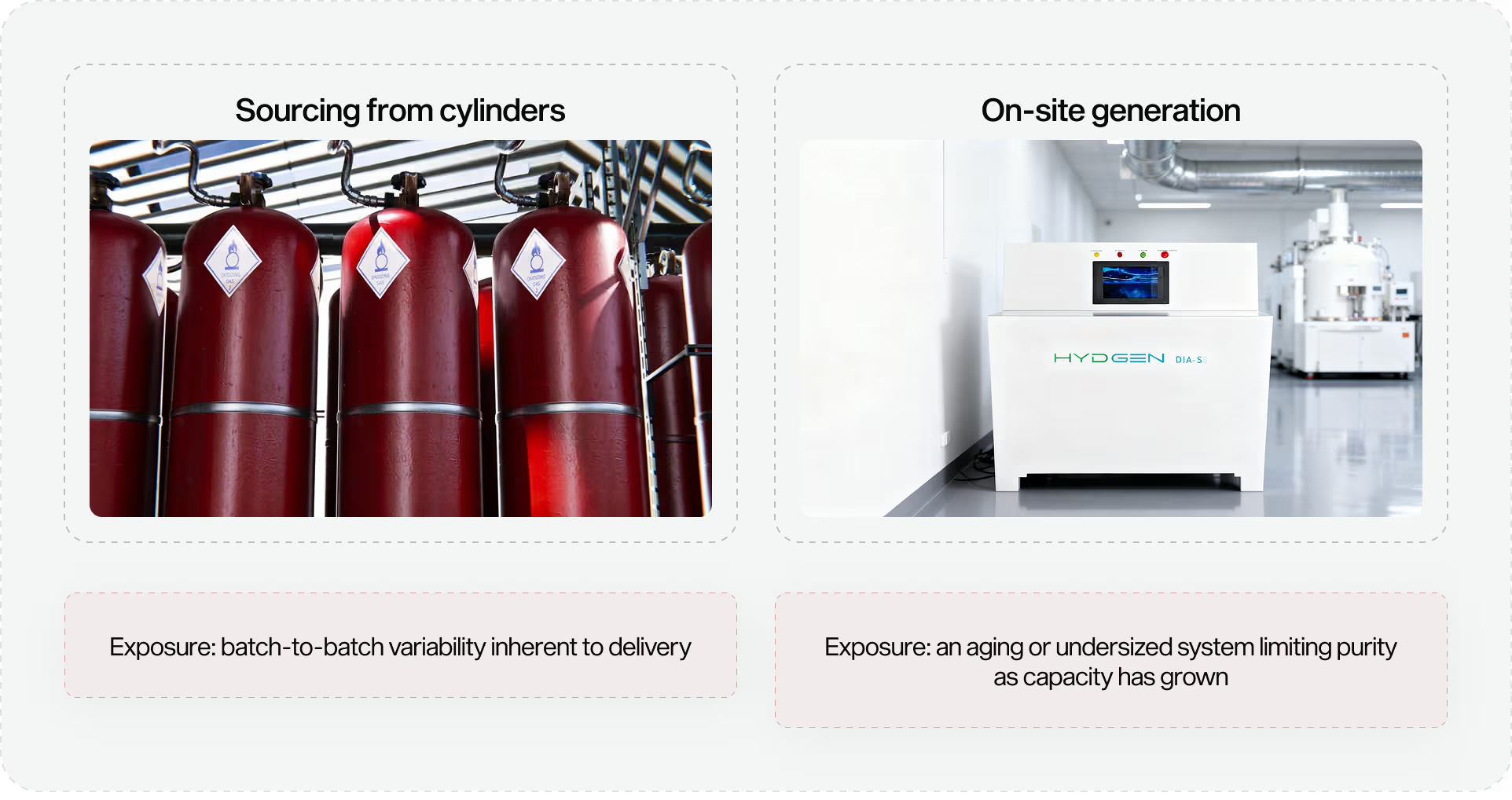
- If sourcing from delivered cylinders, the exposure is supply and purity variability inherent to batch delivery.
- If already running on-site generation, the exposure is more often an aging or undersized system that has become the limiting factor on purity consistency, uptime, or cost as reactor capacity has grown.
Either way, the fix isn't a higher purity number on a spec sheet. It's a system engineered to hold that number continuously, with the monitoring in place to prove it because in CVD diamond growth, the crystal itself is the record of whether the gas supply held its spec.




Frequently Asked Questions


